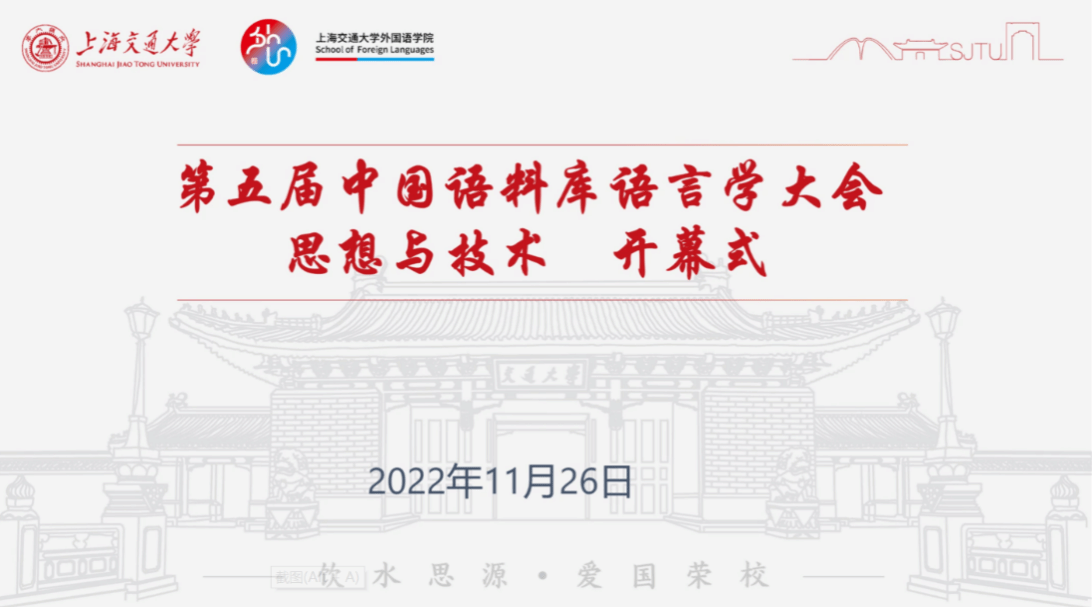
中国英汉语比较研究会语料库语言学专业委员会主办,上海交通大学外国语学院承办,于2022年11月26日至27日在线上举行。
本次会议的会议手册电子版,可从此处读取。
2022年11月26-27日,第五届中国语料库语言学大会由中国英汉语比较研究会语料库语言学专业委员会主办,上海交通大学外国语学院承办。会议围绕语料库语言学研究思想与技术的主题,邀请了全国大学英语四、六级考试委员会原主任委员杨惠中教授以及来自英国伯明翰大学、北京航空航天大学、浙江工商大学、大连外国语大学等高校的语料库语言学专家作大会主旨发言。
开幕式采用腾讯线上会议和哔哩哔哩直播相结合的形式,吸引了全国800余名参会者。
开幕式上,会议主持人甄凤超教授首先对参会专家和在线的师生表示欢迎,并对2003年在上海交通大学外国语学院举办的上海语料库语言学国际会议进行了回顾。此次会议的召开,标志着学院的语料库语言学研究站在了新的起点。
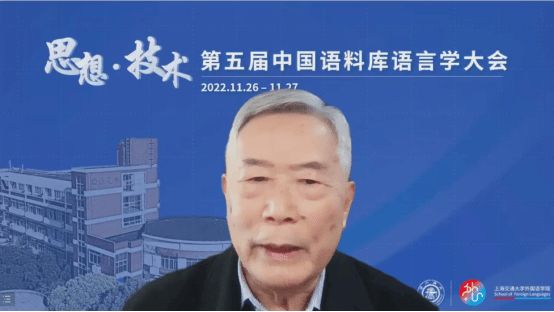
全国大学英语四、六级考试委员会原主任委员杨惠中教授首先致辞。他认为,语料库语言学研究,思想与技术相互依存、相辅相成,新思想可以催生新技术,新技术也可以为语言学研究提供新的思路。语料库未来的发展,除了文本,还要结合大数据技术以及多模态技术,在语料库语言学本体研究方面不断探索和创新。尤其要注重语料库语言学的应用研究,从语言教学、字典编撰等领域,扩展到社会、法律、经济等众多领域。语料库语言学作为跨学科研究领域,在人才培养方面,要注重融入语言学和计算机等相关学科的知识。
中国英汉语比较研究会语料库语言学专业委员会会长梁茂成教授代表主办方进行致辞。他首先对交大外院承办此次年会表示感谢,然后谈了语料库语言学发展的机遇。面对海量数据、多媒体的介入等外部变革,语料库语言学要及时调整方向,应对时代发展的变革。
上海交通大学外国语学院院长常辉代表承办方致辞。他介绍了交大外院语料库语言学源远流长。上个世纪80年代在杨惠中教授的带领下,就已建成了国内第一个大型电子语料库,即科技英语语料库。同时,交大外院培养了一批语料库语言学领域的人才,如今已经成为学术界的领军人物和骨干力量。现阶段,学院整合优势资源,在语料库语言学人才培养、师资队伍建设、科学研究、社会服务等领域,继续贡献交大外院力量。
主旨发言阶段,北京航空航天大学卫乃兴教授作了题目为Corpus Approaches to Discourse Studies: methodologies, Challenges and Prospects的发言,详细讨论了语料库话语研究的三种路径:corpus-based discourse studies (CBDS)、corpus-assisted discourse studies (CADS)以及corpus-informed discourse studies (CIDS)。他还认为未来的研究可适度使用计算语言学的分析技术,例如机器学习,以及在话语分析领域应当借鉴和参照相邻学科的一些思想方法,尤其是传播学、社会学等领域。
浙江工商大学李文中教授作了题目为Textual Data Science for Corpus Linguistic Exploration of Textual Objects and Their Paraphrases的发言。介绍了语料库语言学研究过程中,要注重意义的研究,借鉴数据科学的方法和技术,语料库研究要把握“从文本到数据,从数据再到文本”的研究路径,强调了真正的文本意义分析必须从统计数据回归文本。
大连外国语大学邓耀臣教授作了题目为A multi-dimensional comparison of the effectiveness and efficiency of association measures in collocation extraction的发言。在评估已有的自动识别搭配的联想测评手段的基础上,介绍了他在词语搭配方面的最新研究成果,即检验联想评测手段的多维评价方法,并对在多种文类和不同规模语料库中识别搭配的七种主要联想评测手段进行了检验。
英国伯明翰大学的Michaela Mahlberg教授作了题目为(Corpus) Linguistics in the Digital Age的发言。她指出计算方法以及数据科学和人工智能技术的革新,给语言研究带来许多的变化,但同时应该对于语料库语言学未来发展方向保持清醒认识,要始终坚持语言在数据世界的中心位置。
伯明翰大学的Wolfgang Teubert 教授作了题目为Why Discourse is Not an Object of Science的发言。介绍了意义存在于话语中的理念,对于语言学家来说,主要的任务就是找到围绕话语而产生的意义,强调了人对话语意义的阐释。
与此同时,本次年会还举办7个分论坛,涵盖基于语料库的学术语言研究、基于语料库的话语分析、基于语料库的语言对比和学习者语言研究、基于语料库的翻译研究、基于语料库的汉语研究、语料库文体学研究、语料库技术研究等主题,吸引了来自全国50余所高校的师生参与。
闭幕式上,中国语料库语言学研究会副会长李文中教授代表学会向承办方交大外院、与会专家、参会师生表示感谢,并引用杨惠中教授的观点:未来的发展一方面要坚持正确的语言学思想,另一方面要勇于拥抱新技术,迎接新挑战,开拓创新。
The 5th Corpus Linguistics in China (CLIC2022) Conference
On November 26-27, 2022, the 5th Corpus Linguistics in China Conference was hosted by the Corpus Linguistics Society of China, and organized by the School of Foreign Languages, Shanghai Jiao Tong University. Centered around the theme of concepts and technologies in corpus linguistics research, the conference invited Professor Huizhong Yang, former Chairman of the National College English Testing Committee (CET-4 and CET-6), as well as corpus linguistics experts from universities including the University of Birmingham (UK), Beihang University, Zhejiang Gongshang University, and Dalian University of Foreign Languages to deliver keynote speeches.
The opening ceremony was held in a hybrid format, combining Tencent Meeting with a Bilibili live stream, attracting over 800 participants nationwide.
At the opening ceremony, the conference host, Professor Fengchao Zhen, welcomed the participating experts as well as the teachers and students online, and reflected on the Shanghai International Conference on Corpus Linguistics held at the School of Foreign Languages, Shanghai Jiao Tong University in 2003. The convening of this conference marked a new starting point for the school's corpus linguistics research.
Professor Huizhong Yang, former Chairman of the National College English Testing Committee, gave the first opening remark. He stated that in corpus linguistics research, concepts and technologies are interdependent and complementary. New concepts can give birth to new technologies, and new technologies can also provide new perspectives for linguistic research. The future development of corpora, in addition to text, must integrate big data and multimodal technologies, continuing to explore and innovate in the ontological research of corpus linguistics. Particular emphasis should be placed on applied research in corpus linguistics, expanding from fields such as language teaching and lexicography to numerous other areas including sociology, law, and economics. As an interdisciplinary research field, talent cultivation in corpus linguistics should focus on integrating knowledge from related disciplines.
Professor Maocheng Liang, President of the Corpus Linguistics Society of China, delivered a speech on behalf of the host. He first expressed his gratitude to the SJTU School of Foreign Languages for organizing this annual conference, and then discussed the opportunities for the development of corpus linguistics. Facing external transformations such as massive data and the intervention of multimedia, corpus linguistics must adjust its direction in a timely manner to respond to the changes of the times.
Professor Hui Chang, Dean of the School of Foreign Languages at Shanghai Jiao Tong University, delivered a speech on behalf of the organizer. He introduced the long-standing history of corpus linguistics at the school. In the 1980s, under the leadership of Professor Huizhong Yang, the first large-scale electronic corpus in China—the Jiao Tong University Corpus of English for Science and Technology (JDEST)—was built. At the same time, the school has cultivated a group of talents in the field of corpus linguistics who have now become leading figures and backbone forces in the field. At this stage, the school is integrating its advantageous resources to continue contributing its strength in areas such as corpus linguistics talent training, faculty building, scientific research, and social services.
During the keynote speech session, Professor Naixing Wei of Beihang University gave a presentation titled "Corpus Approaches to Discourse Studies: methodologies, Challenges and Prospects", detailing three approaches to corpus discourse studies: corpus-based discourse studies (CBDS), corpus-assisted discourse studies (CADS), and corpus-informed discourse studies (CIDS). He also suggested that future research could appropriately utilize analytical technologies from computational linguistics, such as machine learning, and that the field of discourse analysis should draw upon and reference the concepts and methods of adjacent disciplines, especially in areas like communication and sociology.
Professor Wenzhong Li of Zhejiang Gongshang University delivered a speech titled "Textual Data Science for Corpus Linguistic Exploration of Textual Objects and Their Paraphrases". He introduced that in the process of corpus linguistics research, emphasis should be placed on the study of meaning, drawing on the methods and technologies of data science. Corpus research must grasp the research path of "from text to data, and from data back to text", emphasizing that genuine textual meaning analysis must return from statistical data to the text itself.
Professor Yaochen Deng of Dalian University of Foreign Languages gave a speech titled "A multi-dimensional comparison of the effectiveness and efficiency of association measures in collocation extraction". Based on an evaluation of existing association measures for automatic collocation extraction, he introduced his latest research findings in word collocation—a multi-dimensional evaluation method for testing association measures—and examined seven main association measures for identifying collocations across multiple genres and in corpora of different sizes.
Professor Michaela Mahlberg from the University of Birmingham in the UK delivered a presentation titled "(Corpus) Linguistics in the Digital Age". She pointed out that innovations in computational methods, data science, and artificial intelligence technologies have brought many changes to language research. However, at the same time, a clear understanding of the future development direction of corpus linguistics should be maintained, always insisting on the central position of language in the data world.
Professor Wolfgang Teubert from the University of Birmingham gave a speech titled "Why Discourse is Not an Object of Science". He introduced the concept that meaning exists within discourse, and that for linguists, the main task is to find the meaning generated around discourse, emphasizing human interpretation of discourse meaning.
Meanwhile, this annual conference also hosted 7 concurrent sessions covering topics such as corpus-based academic language research, corpus-based discourse analysis, corpus-based language comparison and learner language research, corpus-based translation studies, corpus-based Chinese studies, corpus stylistics research, and corpus technology research, attracting the participation of teachers and students from more than 50 universities nationwide.
At the closing ceremony, Professor Wenzhong Li, Vice President of the Corpus Linguistics Professional Committee, thanked the organizer (School of Foreign Languages, SJTU), the participating experts, and the attending teachers and students on behalf of the association. He also cited Professor Huizhong Yang's viewpoint: future development must, on the one hand, adhere to correct linguistic concepts, and on the other hand, boldly embrace new technologies, meet new challenges, and pioneer innovations.



See also: https://sfl.sjtu.edu.cn/En/Data/View/6410